
Description
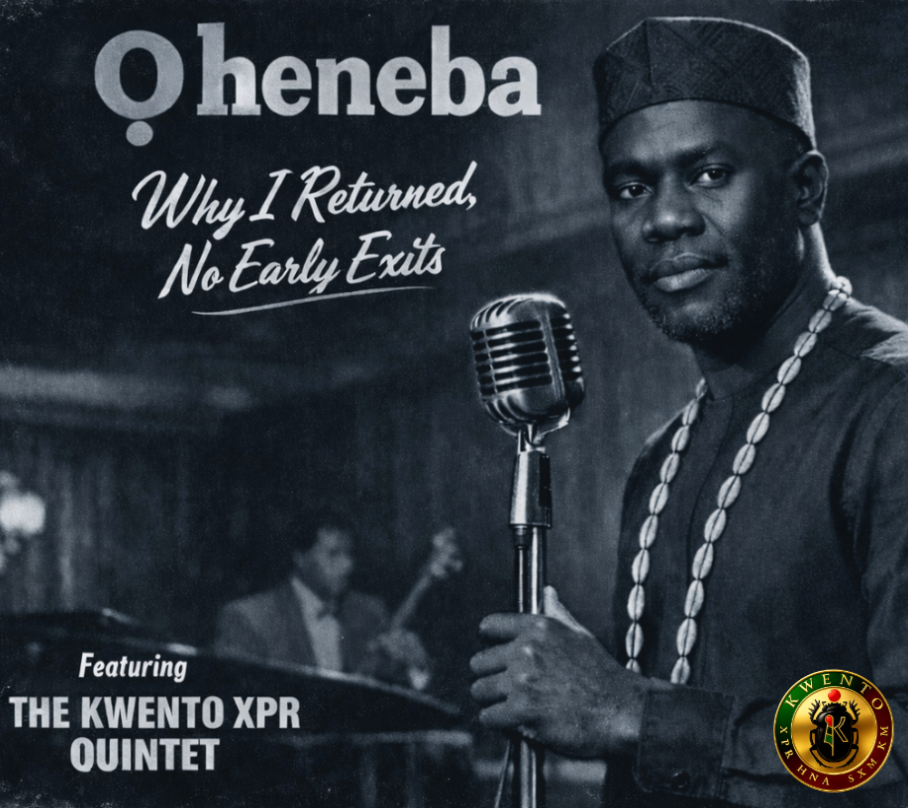
Why I Returned, No Early Exits — Ọheneba (2026)
Under the banner Kwento xpr Hna sxm km, Why I Returned, No Early Exits is the inward-facing
volume of the lineage — a maintenance manual for return already underway. If Make KMT BLACK
Again sounded the command, Visions of KMT trained the senses, Recapturing KMT enforced
confrontation, and Tukula lived inside midday power, this record asks a quieter, harder question: how
do we maintain Ma’at intact inside ourselves once we are home?
Ọheneba turns the lens inward, treating return as a daily practice — the consistent work of driving out
isfet and restoring Ma’at in thought, word, and deed. The album understands that power is lost less
often through invasion than through neglect. Alignment, here, is not abstract; it is patterned, repeated,
corrected. Return is framed as a lifelong choice with no early exits.
Sonically grounded in 1950s–1960s bebop and hard bop jazz, the project moves with restraint and
precision. Instrumentals breathe, solos converse, and time stretches just enough to invite reflection. The
sound mirrors the message: balance is maintained through attention, not force.
TRACK JOURNEY
Through the Blackland opens with clear-eyed reverence. Abibiman is presented not as backdrop, but
as responsibility — land whose beauty demands restoration to a state where power is continuous and
the sun never sets. Before 10 establishes discipline as the first habit of return. Nation work is not
postponed until convenient hours; it is patterned into the day, prioritized before distraction can dilute
intention. Walking Back from the Edge names subtle self-destruction — habits that slowly sever
destiny. The track marks the moment of recognition and the decision to choose life, health, and
continuity over quiet collapse. All My Selves addresses internal contradiction. We are composites —
multiple selves converged — and alignment requires refusing to let any part of us undermine the
whole. Unity begins inside. Bend with the Current reframes strength as responsiveness. Nature is not
resisted; it is partnered. The lesson is clear: rigidity breaks, rhythm endures. Next Stop turns a train
ride into instruction. Abibifahodie is the destination, yet many step off early — comfort, compromise,
distraction posing as arrival. The song urges commitment to the full journey. The More is the tribute to
Nana Abibifahodie Kamau Rashidi Kambon, honoring the poem (The More) that teaches the more
you know about being Black, the more you will love being Black. Don’t Pet Neanderdog offers a
warning in story form. aAmw presence in Abibiman is rendered as something some mistake for
harmless. The bite, when it comes, is never accidental. A Life Worth of Libation conducts an
assessment. The question is not longevity, but quality — whether one’s life has been lived in balance,
service, and readiness to be honored among the ancestors. Ìjèawelē closes with appreciation. The
album ends not in declaration, but in acknowledgment — a shared journey, walked deliberately,
together, aware that cycles continue and return is ongoing.
WHY IT MATTERS
• It defines return as maintenance, not arrival — a daily discipline of internal correction.
• It frames Ma’at as something kept alive through practice, not proclaimed.
• It exposes isfet as often internal, subtle, and habitual — requiring constant attention.
• It models how personal alignment strengthens communal and national stability.
• It affirms that liberation has no shortcuts: no early exits, no partial commitments.
A full lyrics booklet accompanies the release, reinforcing that this is music meant to be used — recited,
studied, annotated, and embodied.
Total Runtime: 35:20
Imprint: Kwento xpr Hna sxm km
Directive: NOT TO BE SHARED ON CESSPOOL MEDIA PLATFORMS



Nkanyezi –
Oheneba reminds me of a hug and wisdom from my Gmama. Thankh me later for letting you know how to feed your soul properly. Oheneba is music and wisdom in words, guiding us to better ourselves and nourish our communities; this is what I call legacy listening. This album and all the albums made by The Kwentos are a legacy, listening and guidance for generations to come, music to live by. For too long, music has been used against Kmtyw people because we live by rhythm and purpose, but aAmyw have used that against us and put self-destructive/deadly music in our way and discredited “living” music. With each album, The Kwento’s create another Kmtyw lives and is empowered. Oheneba is another example of how to kill the music that’s destroying our culture, mental strength, physical, and emotional balance, which is our innate strength, with every album we regain our strength as Kmtyw. Oheneba is a healing we all need. These songs are healing me, my children, and people I come into contact with, returning memories of love, life, and thriving, and making new moments into beautiful memories. Ohenba makes you feel like you’re with your elders, being loved unconditionally. For me, it is sitting on the porch eating watermelon with my cousins or making sun tea with my GrandMargaret. Every album transports me to a time and space of unconditional love, infinite wisdom and nourishes my spirit. I am grateful.