
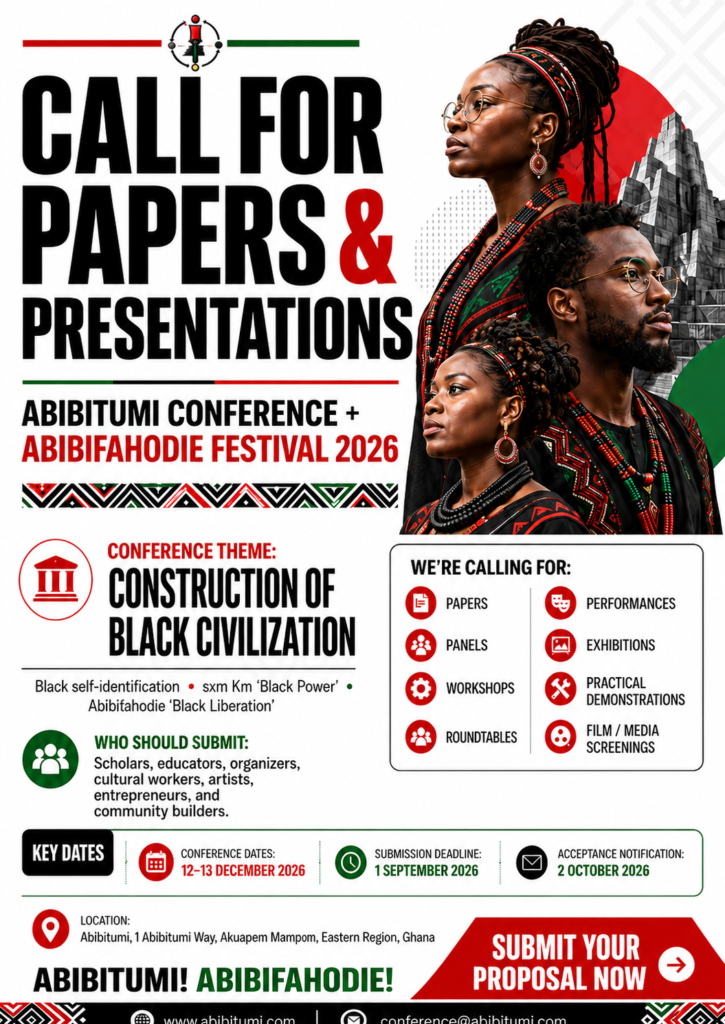
Call for Papers & Presentations
Abibitumi Conference + Abibifahodie Festival
Conference Theme: Construction of Black Civilization
ABIBITUMI! ABIBIFAHODIE!
The Abibitumi Conference and Abibifahodie Festival invite scholars, educators, organizers, cultural workers, artists, entrepreneurs, and community builders to submit proposals for papers, panels, workshops, roundtables, performances, exhibitions, and practical demonstrations aligned with the 2026 conference theme:
Construction of Black Civilization
Black self-identification → sxm Km “Black Power” → Abibifahodie “Black Liberation”
This convening is dedicated to disciplined civilizational building through self-definition, institution-building, mAat-based governance, defense against incursion, independent development, reconstruction of knowledge systems (sbAyt nt Kmtyw), and coordinated diaspora alignment—not merely discussion, but replicable models that can be deployed in communities.
Conference dates: Saturday 12 December – Sunday 13 December 2026
Location: Abibitumi, Akuapem Mampɔn, Eastern Region, Ghana (1 Abibitumi Way).
Ready to submit?
Send your paper, presentation, workshop, performance, exhibit, or activation proposal through the guided submission form.
Submit Paper / Presentation ProposalWhat We Are Calling For
We welcome proposals that:
- strengthen Black self-identification as a civilizational foundation
- build structures for sxm Km “Black Power” (institutions, networks, disciplined practices)
- accelerate Abibifahodie “Black Liberation” through concrete systems (education, economy, governance, media, culture, youth formation, protection)
Conference Tracks
Track 1 — Naming, Identity, and the Construction of Meaning
- Endonyms vs exonyms; naming as civilizational infrastructure
- Countering miseducation/disinformation as identity warfare
- Language policy for institutions; disciplined terminology and framing
Track 2 — Dikènga, wHm mswt, and Cycles of Black Self-Identification
- Historical patterns of resurgence and renewal
- How threat conditions shape strategy and consolidation
- Cycle literacy for planning long struggles and long builds
Track 3 — sxm Km “Black Power” as Civilizational Infrastructure
- Common language, cohesion, and scalable institution design
- Building durable organizations that outlive personalities
- Diaspora alignment through systems, not slogans
Track 4 — Defense Policy, Borders, and Anti-Incursion Strategy
- Repelling incursion as policy (not reaction)
- Movement integrity: anti-cooptation and anti-infiltration discipline
- Organizer safety: operational security, intelligence, and community protection
Track 5 — mAat as Governance, Ethics, and Leadership Discipline
- mAat as a practical governance code (accountability + enforcement)
- Leadership as service; institutional integrity and trust
- Preventing internal corrosion: corruption-proof structures
Track 6 — Independent Development and the Liberation Economy
- Internal trade networks; coordinated Black enterprise
- Land, production, supply chains, and durable economic systems
- Mutual aid → mutual investment; household and community independence models
Track 7 — sbAyt nt Kmtyw: Rebuilding Knowledge Systems
- Methods rooted in Black people’s interests and realities
- Evidence standards, primary sources, disciplined interpretation
- Curriculum-building, pedagogy, and knowledge institutions as civilization work
Track 8 — Homecoming, Repatriation Pathways, and Diaspora Integration
- Homecoming as structure (education, land, community responsibilities)
- Building durable global nodes across territories
- Integration models that strengthen civilizational continuity
Abibifahodie Festival Proposal Areas
We invite proposals that translate civilizational construction into lived experience, including:
- Language activations (micro-lessons, naming ceremonies, “write your name” stations)
- Arts, fashion, drumming, dance, and performance rooted in Black cultural continuity
- Media production (podcast booth, interviews, screenings + talkbacks)
- Liberation marketplace demonstrations (products + systems + pathways)
- Sankɔfa Children & Youth programming (story, games, leadership formation)
- Wellness and healing sessions aligned with mAat-centered wellbeing
- Preparedness and community protection demonstrations (discipline + planning)
Formats Accepted
- Individual Paper (15–20 minutes)
- Panel (3–5 presenters, 60–90 minutes)
- Roundtable (5–8 contributors, 60–90 minutes)
- Workshop / Practicum (hands-on, 60–120 minutes)
- Lightning Talk (8–10 minutes)
- Poster / Exhibit (visual display + discussion)
- Film / Media Screening + Talkback
- Festival Performance / Demonstration / Activation
Submission Requirements
Submit one proposal (one document) including:
- Title
- Format (paper/panel/workshop/etc.)
- Track / Festival Area (choose one primary area)
- Abstract (250–400 words)
- What are you building, proving, or modeling toward the Construction of Black Civilization?
- What evidence/method/experience grounds the work?
- What will attendees leave with or be able to apply?
- 3–6 keywords
- Presenter bio (100–150 words)
- AV / space needs
- Contact information (name, email, phone)
Strongly encouraged for workshops/activations: a 1-page participant outcomes sheet (template/checklist/code/curriculum unit plan/etc.)
Review Criteria
Proposals will be evaluated for:
- alignment with Construction of Black Civilization
- clarity, discipline, and usefulness (not vague assertion)
- evidence, method, or grounded experience
- contribution to durable structures for sxm Km “Black Power” and Abibifahodie “Black Liberation”
- feasibility and participant experience
Key Dates
- Submission deadline: Tuesday, 1 September 2026
- Notification of acceptance: Friday, 2 October 2026
- Final program confirmation: Friday, 30 October 2026
- Conference + Festival: Saturday 12 December – Sunday 13 December 2026
Where to Submit / Contact
Submission form: Use the guided form below. For questions, email conference@abibitumi.com.
Submit a Paper, Presentation, or Activation
Use this guided form to submit your proposal for the 2026 Abibitumi Conference + Abibifahodie Festival. You can submit papers, panels, workshops, roundtables, performances, exhibits, screenings, or practical demonstrations.
(Email + venue details are listed on Abibitumi’s official site.)