
 The Afrikans Who Emancipated Themselves
  13,000 Years in 13 Minutes: Humanities and Sciences as Complementary Aspects of an African Whole
  Chanting YorùbÁkan: A Stylistic Analysis of Jími Ṣólańkẹ́’s Ọ̀nà là in “The Path”
  “You Can Sit Down Next to white Folks – on the Toilet” – Integration, Apartheid, and Untouchability
  Intro Yoruba Intensive Workshop Text + Audio [PDF + mp3]
  Recording: Yorùbá Workshop: Ifá, Òrìṣà and Egúngún Songs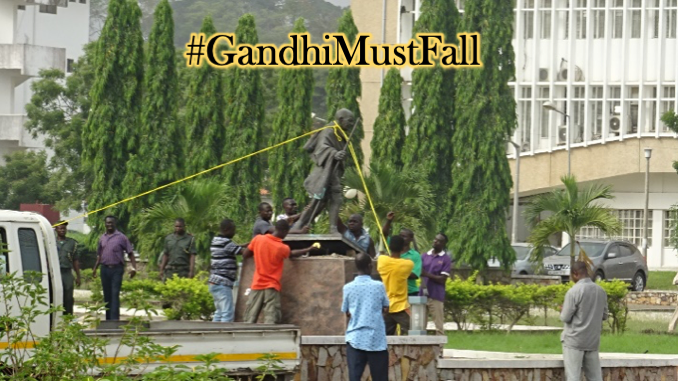
Description
Ma’at and srwḏ
tꜢ n Kmt ‘Restoring the
Land of Black People’
There are several problems with the concept of
decolonization and/or decoloniality that I aim to delineate in this chapter.
The first problem is using a colonial language with which to conceptualize
reality. The second is conceiving of time as a line which includes
pre-colonial, colonial, and post-colonial. The third is rooting one’s identity
and self-definition in the anticipated presence, the current presence, or the
ostensible leaving of one’s colonial enemy. In this chapter, using comparative
historical analysis, I argue that #gandhimustfall was not about decolonization
(A hot buzzword which attracts big funding from entities like the Mellon
foundation). In comparison with what I term Amnirense (Amanirenas) qore li kdwe
li’s #augustusmustfall campaign, #gandhimustfall is framed here as part and
parcel of a continued effort in the cyclic multi-millennial effort towards
srwḏ
tꜢ n Kmt ‘Restoring the
Land of Black People’ and the restoration of mꜢꜤt ‘Maat’: a continued effort to
prevent the encroachment of non-Black eurasians into the land of Black people
and, when this is not possible, to drive them out whenever they (or their
images designed to project soft power) enter our land.



![[125 Slides + Video!!!] The most comprehensive case for Gandhi's anti-Black racism ever researched and presented](https://media.abibitumi.com/wp-content/uploads/2025/07/12073734/gandhi-500x500.jpg)