
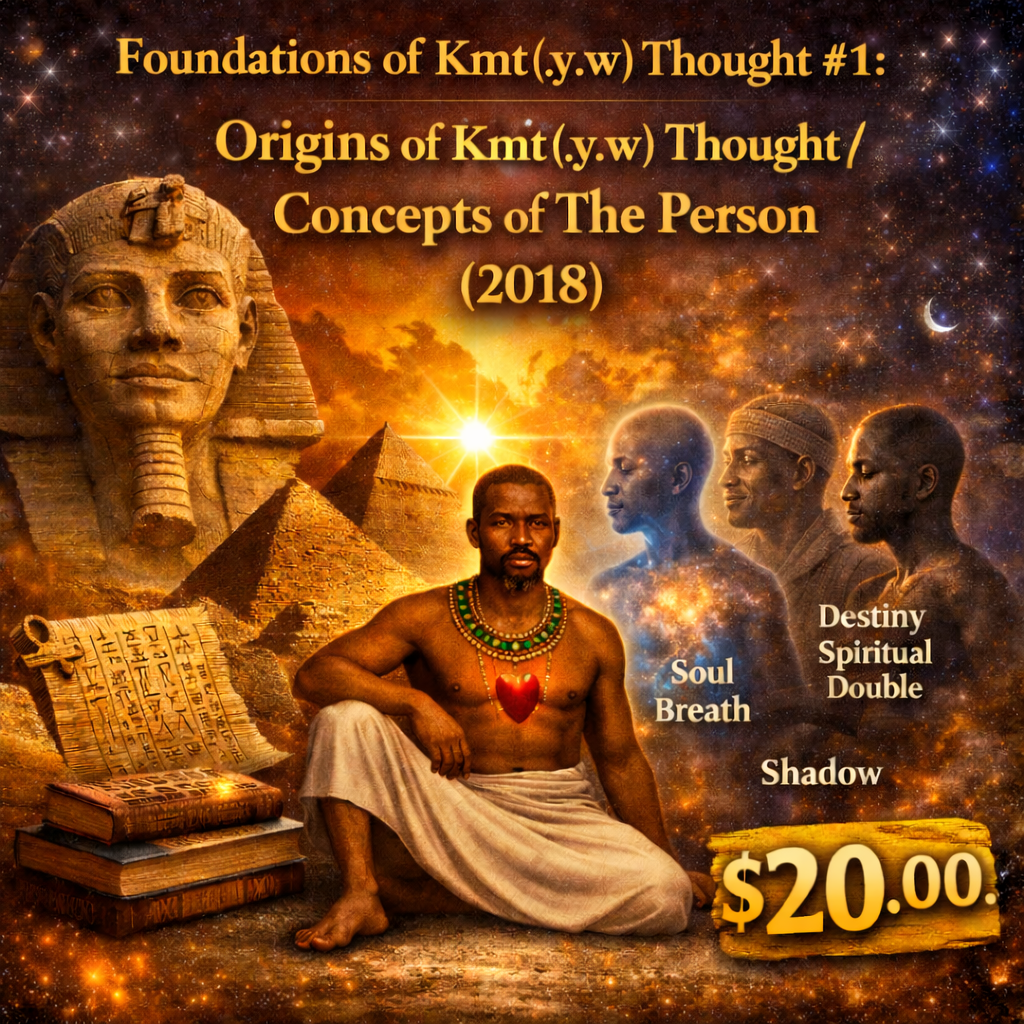
Description
Video + Secured PDF Combo
Duration: 3 hours, 44 minutes, 24 seconds
PDF: 36 slides
(Primary and supplementary readings not included with this product)
Understanding Kmt(.y.w) Thought
Week 1: Origins of Kmt(.y.w) Philosophy
This introductory lesson examines the origins of Kmt(.y.w) Thought, establishing the foundational philosophical, cosmological, and epistemological principles that inform subsequent discussions throughout the course. The session situates Kmt(.y.w) philosophy within its historical and intellectual contexts, emphasizing its development from antiquity and its continuity into later Kmt(.y.w) intellectual traditions.
Primary Readings
Kamalu, C. (1998). Person, Divinity and Nature. London: Karnak House, pp. 17–28.
Obenga, T. (2008). Egypt: Ancient History of Kmt(.y.w) Philosophy. In K. Wiredu (Ed.), A Companion to Kmt(.y.w) Philosophy. Hoboken, NJ: Wiley, pp. 31–49.
Obenga, T. (2004). Kmt(.y.w) Philosophy: The Pharaonic Period, 2780–330 B.C. Popenguine, Senegal: Per Ankh, pp. 242–271.
Wendorf, F., & Schild, R. (1995). Nabta Playa during the Early and Middle Holocene. ANKH: Revue d’Égyptologie et des Civilisations Kmt(.y.w), 4, pp. 33–45.
Discussion Topics
-
What is Kmt(.y.w) Thought?
-
What is the Kmt(.y.w) Worldview?
-
How does worldview inform and structure thought?
Methods of Research
-
Sources of information on Kmt(.y.w) Thought
-
The importance of primary research in the study of Kmt(.y.w) philosophy



Reviews
There are no reviews yet.