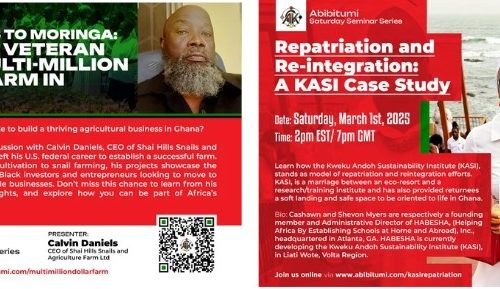
 Repatriation and Re-Integration and Multi-Million Dollar Farm Business Bundle Seminar March 1-2nd
  Video Replay: Repatriate to Ghana – Interest & Sharing Session ft. Ɔbenfo Ọbádélé Kambon & Asantu Kweku Maroon
 -
“And so you must understand that what you have to do is to respect the ancestral tradition. We have to put our ancestral traditions together because the people who have been at war against us, have tried to break our connection with our ancestors. They have tried to debase our ancestors, to accuse our ancestors of paganism and savagery and ignorance and therefore we go around ashamed of our ancestors. But what we have to understand is that however much our ancestors might have not seen everything clearly, they were trying the best they could to get out of this mess and to leave a better world for us than they found it. And we have to…continue that tradition. We have to practice those rituals and show respect for those rituals. We have to realize that life for us is a series of developmental stages and every one of those stages we have to celebrate. We have to come to the temple as a community in order to revitalize ourselves, in order to renew that Maat that is within us all.”
-Jacob H. Carruthers
6 Comments-
I overstand Nana Carruthers’ is referring to pre-Maafa ancestors with traditions intact. However, the issue is, most contemporary Maafa Afrikans reading this passage will think of recent Maafa Ancestors that adapted colonial elements into their cultures and now those are referred to ancestral traditions. Even in the Blackest communities of the Diaspora with cultural Afrikan retention there’s the adoration of white saints because it’s considered ancestral tradition now. E.g., Afrikanized Catholicism is considered ancestral tradition in the Diaspora. Older pre-Maafa ancestors are forgotten, our memory only goes so far as to the Maafa ancestors that were forced to create what they could out of the situation they were in. It’s very difficult for most Maafa Afrikans to let go of those colonial elements that are now deemed ancestral culture, especially with the added authoritative veneration of “ancestral”. Thus, the term “ancestral” itself has become confusing and problematic for many Diasporic populations. I have a bredrin who argues, it’s been overly misappropriated/misused.
-
I use the Izon term Opuaduwei instead of “ancestors”
-
mo mo mo!
-

i use the word
mfhʉ́sīē
coming from the root word
fhʉ́sīē— meaning who comes from the soil, ground, earth
-
-
-

This one is hard for people understand because most come with that linear understanding of thinking Maat is ancient Egypt and reciprocity blah blah blah. Maat is any place African people are sovereign and it will manifest itself in the people. Haiti is a good example you see all the principles of maat-vodon at work through each individual, they are literally the embodiment of principles. It doesn’t matter if you call it Maat, vodon, Islam, Christianity, Rastafarian, or hoodo. Maat is wherever African people are in unity of purpose. It is an idea about the forces of the universe working within us that we must be able to recognize and move in harmony with. We are literally the flesh that lets the infinite experience time. But to many of us put it off into principles and far away concepts and this is understandable since it’s not physically manifested in our actions today. And too many of our educators who write all these books try to mystify and spookify it imo.
-