-
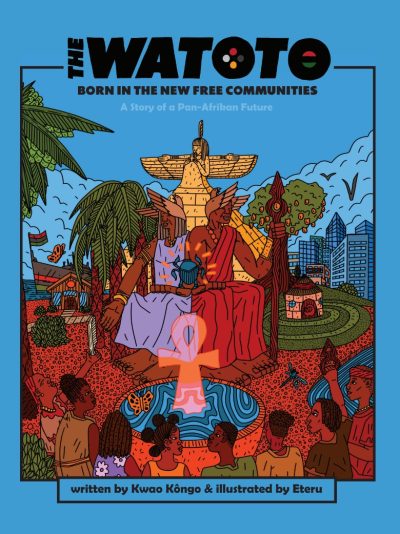
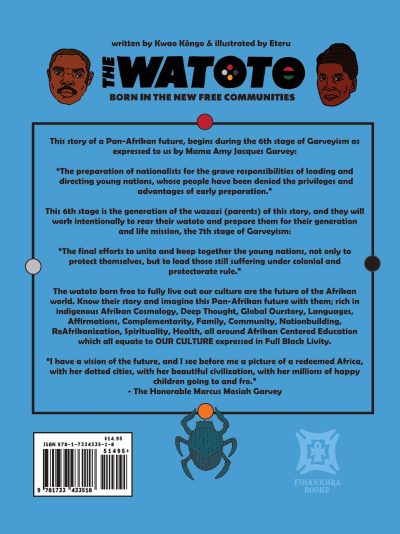
Fihankhra Books is raising funds to print the next batch of copies of The Watoto Born in the New Free Communities, A Story of a Pan-Afrikan Future, from a Black printer. We are looking to getting the book distributed through the Afrikan/Abibiman World with those who support. For those who don’t know of this book, it is an illustrated family book (as opposed to just children’s because adults can learn too) released in April of this year, that envisions a Pan-Afrikan future incorporating the best of our past, and Abibitumi is a part of it, as it had direct impact on some of its content. Its first 100 copies have run out and it’s received good reviews; to include the one we were honored to receive by Baba Mwalimu Baruti – which I’ve included below. Asante sana to @Makiya and @bakari-kwento who initiated the support. https://donorbox.org/help-us-print-more-booksHelp Us Print More Books | Fihankhra Books (Powered by Donorbox)donorbox.org
Baba Mwalimu Baruti’s Review:
Review of Kwao Kôngo’s book The Watoto by Mwalimu K. Bomani Baruti
“Kwao Kôngo’s The Watoto is a breath of positive, Sankofanized air in a reality of stagnant, regressive, anti-Afrikan “noise and confusion.” It does so much to assist us on our road of identity, purpose and means. Being full of Afrikan names, places, ideas and ourstorical farsightedness, it is destined to make many a Warrior-in-Training’s day, week, month, year and lifetime. On its pages, we find a large collection of deep Afrikan concepts can be found. Reconceptualizations, the refitting of language to fit a Warrior’s intellectual needs, abound. The elements of consciousness are embedded here for those in pursuit of a revolutionary mind. At a glance, a significant indicator of this spirit is evident in the map of Afrika appearing in its cardinally correct geographical position. This was only one of the many things which caught my eye. For Warriors and Warriors-in-Training alike, The Watoto is an explanation of what Sankofa, as a process, actually looks like. It is a powerful journey that Warriors-in-Training cannot help but positively see themselves positively in. No discussion with our watoto of what could be, and what we must return to if we are to again be sane, would be complete without it. The curious young minds in our villages could not help but see our vision, and their assignments in it, if they were led to read it. Masterfully worded, it contains all the reAfrikanizing vocabulary that those of us who want everything our children encounter to improve their frontline thinking skills need. Additionally, each word and concept is well-defined within a Sankofanized communal context and centered in the kind of politicized explanations that they need to actually Be Afrikan. The Watoto is one of those adult-child sit-down together readings destined to become an Afrikan centered classic. There is so much of us on the pages and between the lines. As is commonly said of things that grow as you intellectually mature as a person, there are layers to this book. So, it makes no sense to limit it to one age or another. The words, ideas and interpretations of reality of so many of our greatest thinkers and doers are found on its pages. And, as should be expected in the books created for our children, there is a heavy emphasis on character and character development. Naturally, without this, it would not be ours. In an attempt to visualize what they must do, many times Warriors have asked what an untainted Afrikan reality would look like for us. This book captures it, if not in its totality, then in its fundamentalism. In every thought, you see Ma’at. I am quite sure that it will be read over and over again by those Watoto blessed enough to have knowledgeable and loving parents and guardians who see the need to intergenerationally work toward making Afrikan people independently empowered and sovereign. Art is supposed to bring life to light and the artwork in this book is truly mesmerizing (in the most positive of ways) and reflective of the humanizing touch we have always brought to this world in just being our natural, spirit-guided selves. In and of itself, each picture in this book, from cover to cover, is a serious study of Afrikan life. By example, the artistic symbols used to indicate that sound is being created are vibrant illustrations of our multi-rhythmic/faceted utterances. The artwork’s symbolism is incredible. We are presented with picture after picture, each worth thousands of Afrikan words, captures the essence of Nommo’s reformative power and movement in creating ordered, balanced, intergenerational realities. Moreover, the symbols have been crafted in such a way that you can actually sense, hear and feel the sound of their generative vibrations. However, while it may appear to be so because of its large size and eye-catching color illustrations which virtually fill every page, this is not just a children’s book, not at all. In fact, it is a read and resources for Afrikans of all ages. Something some might consider trivial, but I believe to be quite worthy for our readers to note, is the placement of commas. We should write the way that we speak and there is spacing in our speech. Commas in our writing cause us to give thoughtful pause as when we verbalize our thoughts. We should be reminded of the critical role commas play in setting apart points which need to be distinguished and given further elaboration. Kôngo’s Watoto is next generation consciousness. That “Watoto born free to fully live out our culture are the future of the Afrikan world” says it all. All involved in the production of this book should be very proud of this their contribution to this story and instruction. I see nothing to add to this worthy ReAfrikanizing, nationbuilding effort.”
donorbox.org
Free Donate Button - Donorbox Nonprofit Fundraising Software
Free Donate Button - Donorbox Nonprofit Fundraising Software

 Ohenenana2 Comments
-

 178,618
Abibitumi Points
178,618
Abibitumi Points
 2
2-

Yooo Nuabarima @obadelekambon medase pa pa!
1
-
-