-

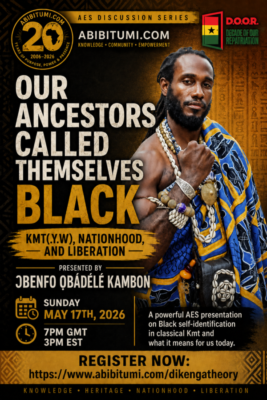
Kmt(.y.w), Nationhood, and Liberation
Presented by Ɔbenfo Ọbádélé Kambon
Sunday, May 17th, 2026
7pm GMT / 3pm ESTWhat did our ancestors call themselves, and what does that reveal about Black identity, nationhood, and liberation today?
Join Ɔbenfo Ọbádélé Kambon for a powerful AES presentation drawn from The Construction of Black Civilization, Volume I. This session explores the Dikènga Theory of Self-Identification as Kmt(.y.w) ‘Black People’ and argues that the people of classical Kmt did not simply exist as a population later renamed by outsiders. Rather, they understood and identified themselves in ways that reflected a conscious orientation to collective being, social organization, political action, and the restoration of right order.
Too often, Kmt(.y.w) is flattened into the vague and depoliticized label “Ancient Egyptians.” This presentation challenges that framing by showing that self-identification as Kmt(.y.w) ‘Black People’ carried historical, social, and political meaning. Drawing on primary textual evidence, Ɔbenfo Ọbádélé Kambon examines how this self-understanding shaped relations among Black people, informed engagement with other phenotypically Black populations who did not identify as Kmt(.y.w), and underwrote opposition to non-Black aAm.w ‘eurasians.’
Using Dikènga Theory as a conceptual lens, this presentation also argues that Black self-identification must be understood as part of a cyclical process of ascent, disruption, and restoration. In that sense, this is not only a presentation about the past. It is also a presentation about us: how we understand ourselves, how we name ourselves, how we organize ourselves, and how we move toward MAat ‘Maat’ and Abibifahodie ‘Black Liberation.’
This is a timely and important session for anyone interested in Black history, language, identity, political thought, and the deep ancestral foundations of liberation.
Why you should attend
- Learn what Kmt(.y.w) really means beyond the limiting label “Ancient Egyptians.”
- Explore powerful primary evidence on how our ancestors identified themselves.
- Gain a deeper understanding of Black identity as active, historical, and political.
- See how Dikènga Theory helps explain cycles of Black rise, disruption, and restoration.
- Connect ancient Kmt to present-day liberation struggle in a meaningful way.
- Engage ideas from The Construction of Black Civilization, Volume I** directly with the author.
- Strengthen your foundation for discussions on nationhood, MAat, and Abibifahodie.
- Be part of a serious AES presentation that speaks directly to who we are and what we must restore.
Register now to join this important presentation and deepen your understanding of Black self-identification, Kmt(.y.w), and the ongoing struggle for liberation.