-

Niger Ends Decades Of French Control Over Major Uranium Mine
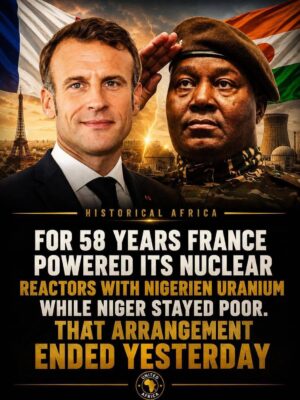
On May 18, 2026, Niger officially revoked France 58-year-old uranium mining concession at the strategic Arlit mining site, previously owned by the French nuclear company Orano.
After nearly 58 years of foreign control over its uranium resources, Niger has made a historic move by kicking out France’s largest uranium company, Orano.
In a significant move, on May 18, 2026, Niger’s Cabinet officially approved a decree cancelling the Arlit mining concession, originally granted to France’s Atomic Energy Commission in 1968. The concession, spanning 360 square kilometers and valid for 75 years, was operated by Orano for over half a century, extracting uranium that powered French homes, hospitals, and industries. Niger’s decision declares the land free of all rights and returns it fully to the Nigerien people. A new state-owned company, Teloua Safeguarding Uranium Mining Company (TSUMCO), will oversee uranium operations on Nigerien soil.
The Niger government said the company failed to pay required taxes and royalties despite repeated warnings.
Orano still faces outstanding tax obligations and environmental accountability for the dramatic impacts on soil, water resources, and biodiversity around the Arlit mining zone. Niger has made the separation from France permanent, legal, and irreversible, after 58 years of uranium extraction that benefited France and European industries while the Nigerien people sat in the dark.
✊🏿 Niger’s military government has officially revoked France’s 58-year-old uranium mining concession at the strategic Arlit deposit. The decision, finalized following a cabinet meeting chaired by military leader President General Abdourahamane Tiani, strips the French state-owned nuclear fuel giant, Orano, of its long-standing extraction rights. Authorities cited Orano’s alleged failure to pay its taxes and surface royalties and a broader push for sovereignty and absolute resource nationalism as the primary justifications for the cancellation. Niger uranium reserves—historically used to power French nuclear plants in Paris—is now open to the international market.
📉 Timeline of the Fallout
- December 2024: The Nigerien military government seizes operational control of its primary uranium mines from Orano.
- June 2025: Niger officially nationalizes the Somaïr mine in Arlit. The government strips Orano of its 63.4% controlling stake, accusing the company of unpaid taxes and royalties and historically taking an unfair, disproportionate share of Niger natural resource wealth.
- June 2025: Niger revokes the operating license for the Imouraren mine, one of the largest untapped uranium deposits in the world.
- December 2025: The dispute escalates into a legal battle and criminal allegations between the Nigerien government and Orano. Niger accuses Orano of predatory behavior and environmental crimes involving radioactive pollution. Simultaneously, Paris prosecutors open a $310 million investigation into the alleged “organized gang theft” of stockpiled uranium transported out of the country without Orano’s consent.
- May 2026: Niger military government officially cancels a historic 58-year uranium concession at Arlit originally granted to France’s Atomic Energy Commission in 1968, citing a failure to pay its taxes and surface royalties.
⚖️ The Post-Colonial Grievances
For over 50 years, Niger’s uranium powered French civilian nuclear infrastructure. While roughly one in three lightbulbs in France was lit by Nigerien uranium, less than 10% of Niger’s own population has access to electricity. The ruling military government, led by President General Abdourahamane Tchiani, has acknowledged this disparity. They also argue that France systematically has underpaid for Niger resources while leaving behind a legacy of “misery, pollution, and desolation”.
💵💰Economic and Geopolitical Impact
- Resource Realignment: Niger has transferred its returned assets to a new state-controlled entity, Teloua Safeguarding Uranium Mining Company (TSUMCO SA). The government has openly looked to pivot its strategic alliances away from France and the West and toward buyers like Russia, Iran, and Turkey.
- Energy Vulnerability: Niger historically supplied over 15% to 20% of France’s uranium imports and over a quarter of the European Union’s uranium supply. The total eviction of the French state-owned nuclear company, Orano, has force France and European energy sectors to aggressively seek alternative mining partners in nations like Botswana, Canada and Kazakhstan.
🌐 Geopolitical Shift & Market Redirection
Niger is the world’s seventh-largest producer of uranium. Having cut its ties with France, the military government has moved away from France and the West and pivoted toward Russia, Iran, and Turkey. The country has placed its 1,500+ ton uranium stockpiles up for international sale to the highest bidder, using regional transit hubs like Togo to export the material.
⚡ France’s Response and New Energy Strategy
Historically reliant on Niger for 15% to 20% of its nuclear fuel imports, France has been forced to adapt:
- Alternative Suppliers: Orano and the French utility company EDF have drastically accelerated import diversification, leaning heavily on existing agreements with Kazakhstan, Canada and Uzbekistan
- The Pivot to Botswana: Orano executives have launched a discreet diplomatic push to secure new mining deals in Botswana, looking to tap into the nation’s estimated 800,000-tonne uranium reserve to replace its lost African portfolio.
- Legal Actions: Orano has rejected Niger’s accusations of economic exploitation and continues to pursue international arbitration through the World Bank’s International Centre for Settlement of Investment Disputes (ICSID) to legally block Niger from liquidating seized uranium stockpiles and seeking full compensation for damages and its seized uranium assets.
africa.businessinsider.com
Niger revokes 58-year French uranium concession at Arlit in sovereignty push
Niger has intensified its overhaul of foreign mining agreements with the cancellation of a 58-year uranium concession linked to France at the strategic Arlit deposit, marking one of the most significant escalations yet in its broader resource nationalism drive


 Bakari Kwadwo Ọbatayé, Percy and 11 others2 Comments
-

Awesome
1 -

 174,638
Abibitumi Points
174,638
Abibitumi Points
Run dem
3