-
 131,125
Abibitumi Points
131,125
Abibitumi Points
Grammar question
My understanding
– dependent pronouns cannot be the subject of a verbal sentence
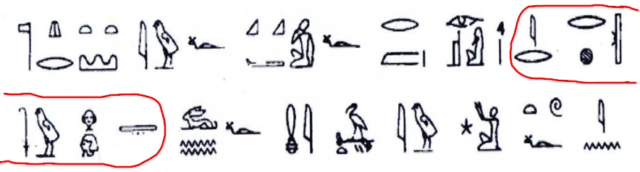
– dependent pronouns can be the subject of a sentence that starts with a particle.Is sw the subject of this sentence since it starts with a particle? Is the translation: If it is known upon the top of the earth


 Kwaku, Kwaeku and 2 others7 Comments
-

nfr sw “it/he is good” — sw is the subject of non-verbal adjective sentence where the adjective functions like a predicate
sDm=i wi “I hear him” — wi is the object of sDm in the verbal sentence
The example you have given
***ir rx sw Hr tp tA***sw is the recipient/object of rx ‘to know’ but it translates as passive in english
rx might be rx.(w) — sometimes third person masculine is implied by context and often not written with the stative.
I will double check, but I’m 75% confident that sw is the direct object of rx
2-
 179,498
Abibitumi Points
179,498
Abibitumi Points
@taharka2018 I agree with you. I’m 99.9999999% positive it is the DO of rx.
1 -
179,498
Abibitumi Points
@taharka2018 in ir rḫ sw ḥr tp tꜣ, sw is better taken as the object, not the subject.
So I would not translate it as “If it is known upon the top of the earth.”
I would take it more like:
“If/As for one who knows it on earth …”
or, in smoother English from the full sentence,
“Whoever knows it on earth will be like Ḏḥwtj.”
Why:
Dependent pronouns can indeed function as subjects in certain nonverbal environments, including adjectival sentences; and after some introductory particles they can also appear as subjects in those sentence types. That part of your understanding is basically right.
But in a verbal clause, a dependent pronoun placed after the verb is very commonly the direct object. That is exactly the normal use described for dependent pronouns.
In the exact sequence jr rḫ sw ḥr-tp tꜣ wnn=f mj Ḏḥwtj, the Thesaurus Linguae Aegyptiae analyzes the words as jr / rḫ / sw / ḥr-tp / tꜣ / wnn=f / mj / Ḏḥwtj and translates the sentence as “Wer ihn auf Erden kennt, der wird wie Thot sein” (“Who knows him on earth, he will be like Thoth”). That supports taking sw as the object of rḫ.
So the grammatical point is:
ir does introduce the clause,
but that does not by itself force sw to be the subject,
because here rḫ sw is best read as “know it/him”, not “it is known.”
A compact parsing would be:
ir = conditional/topical introducer, “if / as for”
rḫ = verbal predicate, “know”
sw = dependent pronoun, object “it / him”
ḥr tp tꜣ = “on earth”
So the clause is essentially:
“if one knows it on earth”
or idiomatically
“whoever knows it on earth.”
The one caution is semantic rather than grammatical: whether sw is best rendered “it” or “him” depends on the antecedent in context. In many rubric-like passages it is naturally “it” = the spell/text/utterance; in the TLA entry the German translation gives “ihn.”
2
-
-
 131,125
Abibitumi Points
131,125
Abibitumi Points
@obadelekambon @taharka2018 dwAw. That was also my original understanding that sw was the DO of rx. Also, my understanding is that (ir rx sw Hr tp tA) is a participle clause where rx contains both the verb and the subject. Therefore, my original translation was: If one who knows it upon the top of the earth.
-
@snKwaku I appreciate the question, I’m shaking off some serious rust LOL.
The reason I got fixed on the ‘passive’ thing is because of something I had read in hoch waaay back — the text i think sbA Bonotchi teaches with — points out that rx is the one transitive verb whose stative form does not translate as ‘passive object’ in stingklish translation (i mixed up the commentary in my initial post).
I also have a petty issue with this ‘passive voice’ thing in stingklish translations, but that’s a whole other issue LOL
 1
1-
131,125
Abibitumi Points
@taharka2018 Anytime. I’m sure I could come up with more grammar questions if you like lol.
-
@snKwaku YES – but no rush lol!
1
-
-
-
-