
Reclaiming the Language of Blackness: Why sbAyt nt Kmtyw Matters

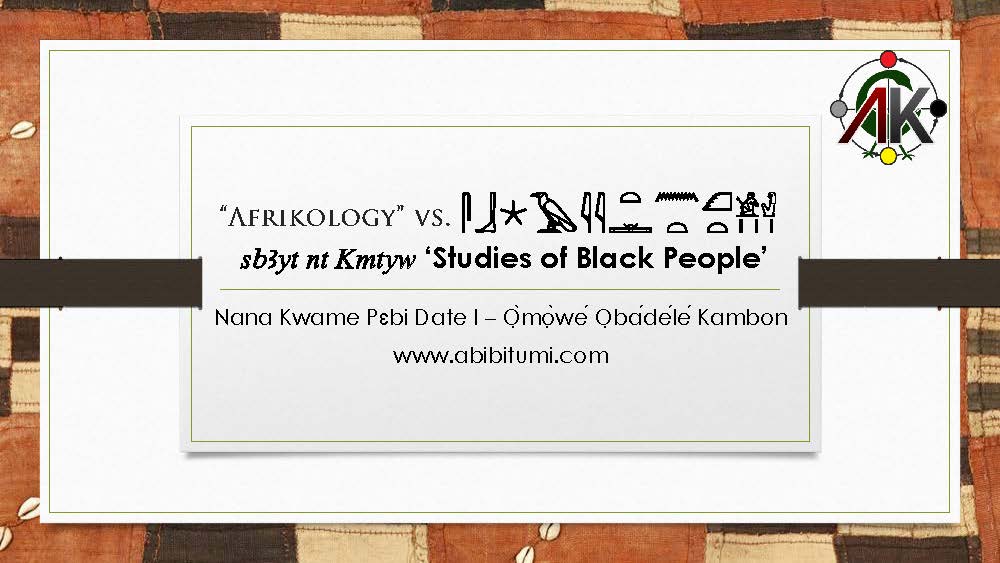
The battle over Studies of Black People begins with a single, powerful question: who owns the language we use to define ourselves? Words are not neutral. They carry history, intention, and power. Furthermore, the roots of any term we use to describe Afrikan people reveal whose worldview we are operating from. This is precisely the terrain that Ɔbenfo Ọbádélé Bakari Kambon enters in this essential presentation — and he enters it armed with primary source texts, linguistic precision, and uncompromising clarity.
The term “Afrikology” sounds Afrikan-centered. However, its roots are firmly embedded in greco-roman linguistic traditions. As a result, it carries the conceptual fingerprints of a non-Afrikan worldview. In contrast, sbAyt nt Kmtyw — meaning Studies of Black People — is indigenous to Black people themselves. Moreover, it locates Afrikan people throughout all of space and time. It does not invite non-Black people into the center of a framework built for us. This distinction is not academic hairsplitting. It is a matter of liberation or continued conceptual colonization.
Why the Language of Studies of Black People Must Come From Us
Ɔbenfo Kambon goes deep into the etymology of both terms. He shows precisely how names shape reality — especially regarding land, belonging, and sovereignty. Most importantly, he addresses what the term Kmt actually means: the land of Black people. Therefore, naming that land and its study using our own linguistic heritage is an act of Abibifahodie. In addition, the presentation tackles the urgent question of non-Kmtyw presence in Kmt — drawing directly from ancient Afrikan source texts. This is Abibitumi at its most foundational: returning the tools of knowledge to the people those tools were always meant to serve.
This lecture is essential for scholars, students, community builders, and every Afrikan person who has ever felt something was missing from mainstream academic frameworks. The work of Ɔbenfo Ọbádélé Kambon does not ask for permission to center Black people. Instead, it demonstrates — through rigorous linguistic and historical scholarship — that centering us was always the only correct path. Consequently, this presentation belongs in every Pan-Afrikan study circle, classroom, and household committed to genuine liberation. Do not sleep on this one.
Watch / Get it here: https://www.abibitumi.com/product/afrikology-vs-sbayt-nt-kmtyw-studies-of-black-people-the-battle-for-conceptualization/
Share This Post


Responses